What Makes HR Systems Effective Over Time
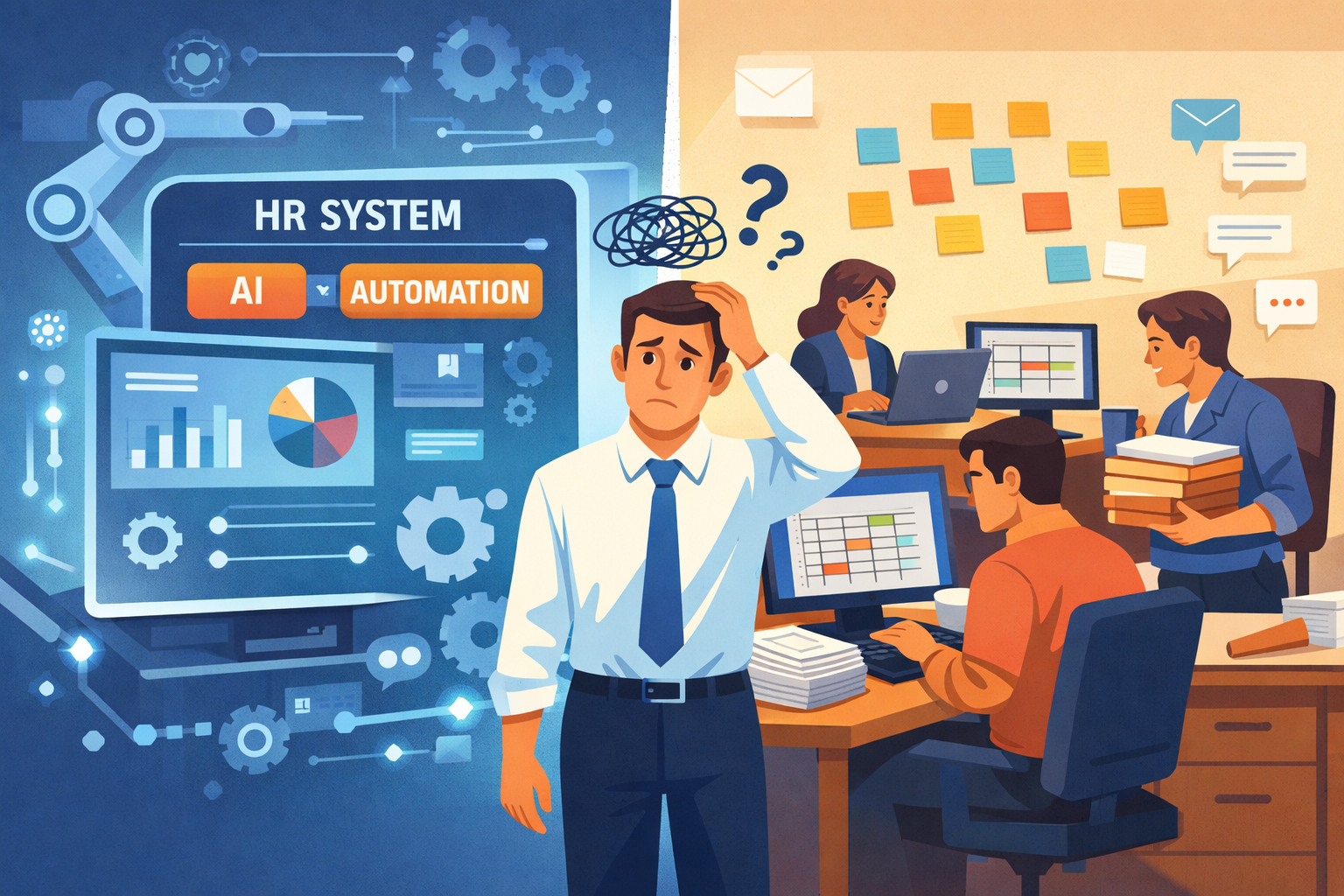
A practical view on HR execution and system design
HR digital initiatives are accelerating
Many organisations feel growing pressure to improve how HR works.
Hiring should be faster.
Reports should be clearer and easier to trust.
Employees expect a better experience.
All of this should happen without adding more people or cost.
At the same time, leaders hear more about new HR systems, automation, and AI. This creates the impression that buying modern tools will quickly solve these problems.
In reality, the results are often disappointing.
The focus is often on tools, not on daily work
When HR results are not where they should be, the discussion usually turns to technology.
Teams compare platforms, look at features, and plan system changes. New capabilities, including automation and AI, are often seen as the answer.
After implementation, many organisations realise that little has changed.
Work is still manual.
Data is still spread across systems.
Reports still need spreadsheets.
What we see again and again in HR projects
Across organisations of different sizes, the same patterns appear.
Companies may already use modern HR systems and still face:
Slow or unclear hiring processes
Manual work outside the system
The same data entered in multiple places
Reports that need manual fixing
The tools are not necessarily bad. They are just not set up to support how work really happens.
This is usually not about choosing the wrong system
A common assumption is that the problem comes from using the wrong tool.
In practice, even very good systems struggle when:
HR processes are not clearly defined
Different teams use different data definitions
Systems do not connect well
Responsibilities are unclear
In these cases, changing tools does not fix the problem. It often creates new ones.
Budget reality shapes HR system decisions
HR technology decisions are rarely made in perfect conditions.
For many organisations, especially small and mid sized ones, HR is not a top investment priority.
Budgets are limited and teams are small. Projects are often split into phases to reduce risk and cost.
Over time, this leads to:
Only parts of the system being used
Important integrations being delayed
Manual steps added to keep things running
Growing complexity in everyday work
These choices are understandable, but they affect how useful the system really is.
More technology does not always help
When pressure increases, the usual response is to add more tools or features.
This often results in:
More systems to manage
More data scattered across tools
Less clarity on who owns what
Lower adoption by managers and teams
Without clear design, more technology often makes HR work harder, not easier.
HR systems shape how work actually gets done
HR systems are often seen as support tools.
In reality, they shape daily work:
How hiring decisions are made
How employees and managers interact with HR
How reliable information is for leadership
If systems are not designed for real use, HR teams are forced to work around them.
Looking ahead designing HR systems that can evolve
Why execution focused guidance matters more than tool selection
Organisations that move forward take a different approach.
They focus first on making HR work clear and practical.
They improve step by step instead of trying to do everything at once.
They accept today’s limits but keep future growth in mind.
At Fishtank Consultancy, we support organisations through this journey by helping them design a clear path forward. The focus is on making HR systems work in practice today, while ensuring they can evolve as needs change and be ready to enable automation and AI.
This approach helps avoid design flaws and unrealistic expectations. It ensures that HR technology supports how the organisation really operates, while enabling both the organisation and HR to improve and grow over time.