Why Strong Interpersonal Collaboration Is Key to Successful HR Transformation

When organizations begin an HR transformation, the conversation usually focuses on technology. Which platform to implement, how to integrate it, and how processes will be configured. Today, this discussion increasingly includes topics such as automation and artificial intelligence.
Yet experience from many HR technology projects shows an important reality:
The success of an HR transformation depends not only on selecting the right HR platform, but also on how effectively people collaborate throughout the implementation journey.
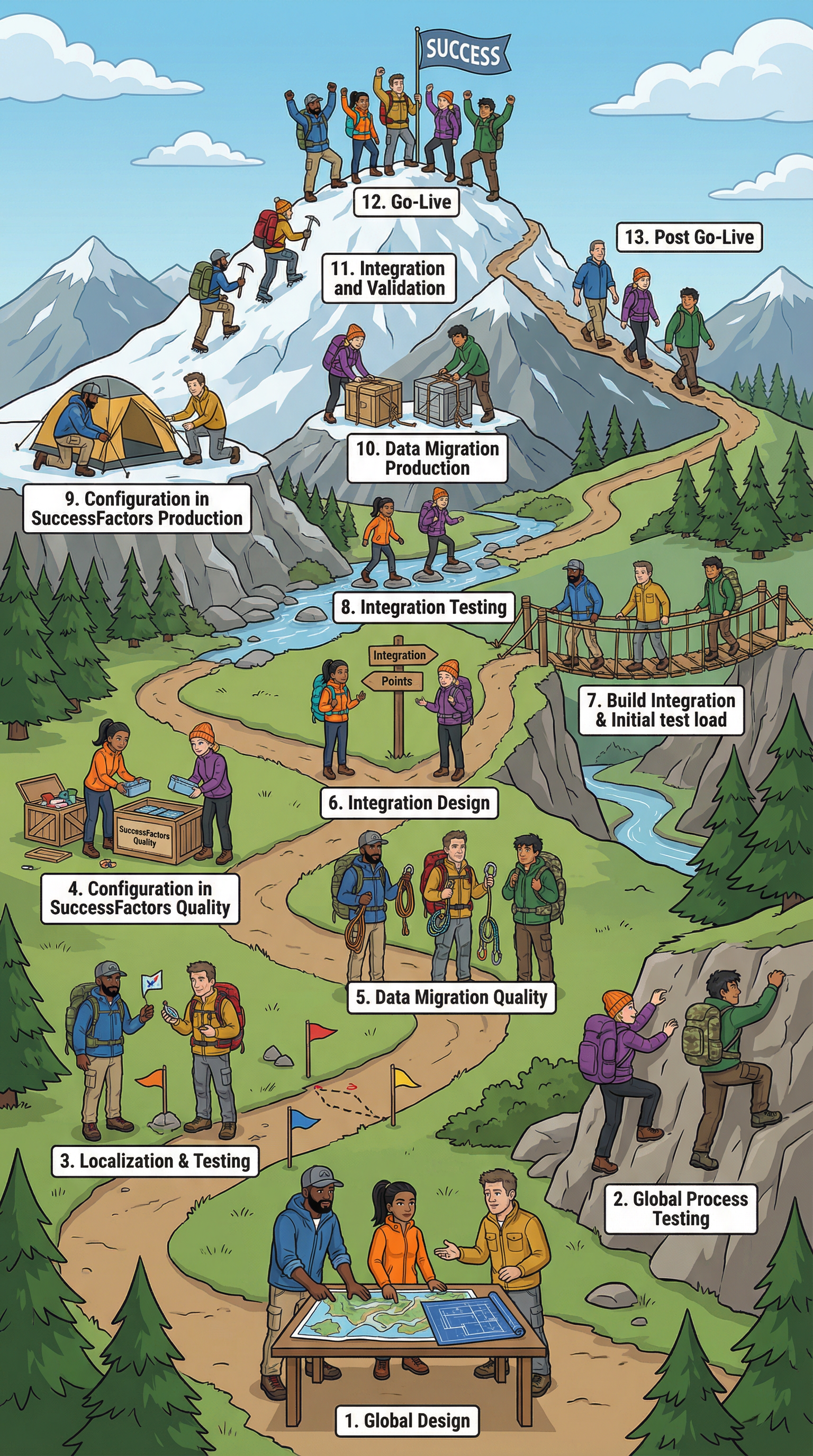
Implementing an HR solution is not simply a technical deployment. It is a journey that requires HR, IT, business stakeholders, and implementation partners to work closely together.
Depending on the size and complexity of the organization, this journey can be relatively straightforward or highly complex. In every case, strong interpersonal collaboration remains a key factor for success.
One way to visualize this journey is like climbing a mountain. The path includes several stages such as global design, configuration, testing, integration, and data migration before reaching the summit at go-live. Each step requires coordination, trust, and shared ownership across teams.
Successful HR transformations are rarely defined by technology alone. They are defined by how well people collaborate throughout the journey.
.
Lessons from the Journey
During the lessons learned review of our most recent HR transformation implementation project, several key observations highlighted the importance of strong interpersonal collaboration.
• Proactive project management creates stability and transparency across teams.
• Clear and realistic scope definition reduces uncertainty and limits change requests during the project.
• Strong interpersonal collaboration builds trust between internal teams and implementation partners.
• Consistent communication ensures alignment between HR, IT, and business stakeholders.
• Pragmatic decision making helps teams move forward when challenges arise.
• Active stakeholder engagement supports adoption across countries and business units.
• Continuous knowledge transfer ensures that internal teams can operate and further develop the solution after go-live.
When these elements are in place, even complex HR transformations can progress with stability and predictability.
Collaboration in Practice
These lessons were clearly visible in our most recent HR transformation implementation project for a global technology manufacturer, where Fishtank Consultancy provided global project management and coordinated the collaboration between HR, IT, and the implementation partner.
“The collaboration with everyone involved was excellent. From the beginning it was a true partnership – collegial but professional at the same time. The project was very well planned and we experienced practically no deviations in timeline.”
The feedback also highlighted the importance of involving stakeholders across the organization early in the project:
“HR teams in the different countries were proactively involved and supported throughout the project. This ensured that all regions delivered on time and now support the solution.”
Even after go-live, the benefits of strong collaboration remained visible:
“Compared to other HRIT projects, the number of post-go-live defects was surprisingly small.”
What SMB Organizations Can Learn
Large global HR transformations often involve multiple countries, integrations, and complex governance structures. However, the lessons learned from these projects are equally relevant for small and mid-sized organizations.
Clear ownership, structured communication, and strong interpersonal collaboration significantly increase the chances of a smooth implementation. Smaller organizations often have an advantage: decisions can be made faster and teams are closer to the business processes they support.
When these principles are applied, HR transformations in SMB environments can move quickly and deliver tangible improvements in a short time.
Technology Enables Transformation. People Deliver It.
Modern HR platforms provide powerful capabilities to manage employee data, support talent processes, and improve operational efficiency.
But technology alone does not guarantee success.
Strong interpersonal collaboration is ultimately what turns an HR system implementation into a successful HR transformation.